Source for feature photo: Arian Fernandez as hosted on Pexels
Every piece of evidence from a crime scene helps investigators put together the puzzle of what occurred. Trace evidence – the biological, physical, or chemical material transferred between people and the environment during a crime – may be the only thing that stands between a hot trail and a cold case. Scientists therefore scrutinize everything they can find to extract as much information as possible. With gunshot residue, for example, laboratory examiners can determine if a gun was fired recently, what kind of gun fired a bullet, and the distance of the shooter and the target. Now, scientists can further determine if the gun had a silencer on at the time of firing, thanks to new work published by Dr. Daniele Merli and his colleagues at the University of Pavia in Italy.
Suppressors, or more commonly silencers, are attached to the muzzle of the gun and subdue, but do not eliminate, the sound and flash emitted upon firing (Fig 1). The firing pin ignites the primer and propellant in the cartridge, producing a rapid expansion of gases that push the bullet out of the chamber. The suppressor, consisting of a series of hollow chambers called baffles filled with inert material, cools and decelerates the gases before they exit the silencer, strongly reducing both the physical recoil and loud noise associated with gunshots.
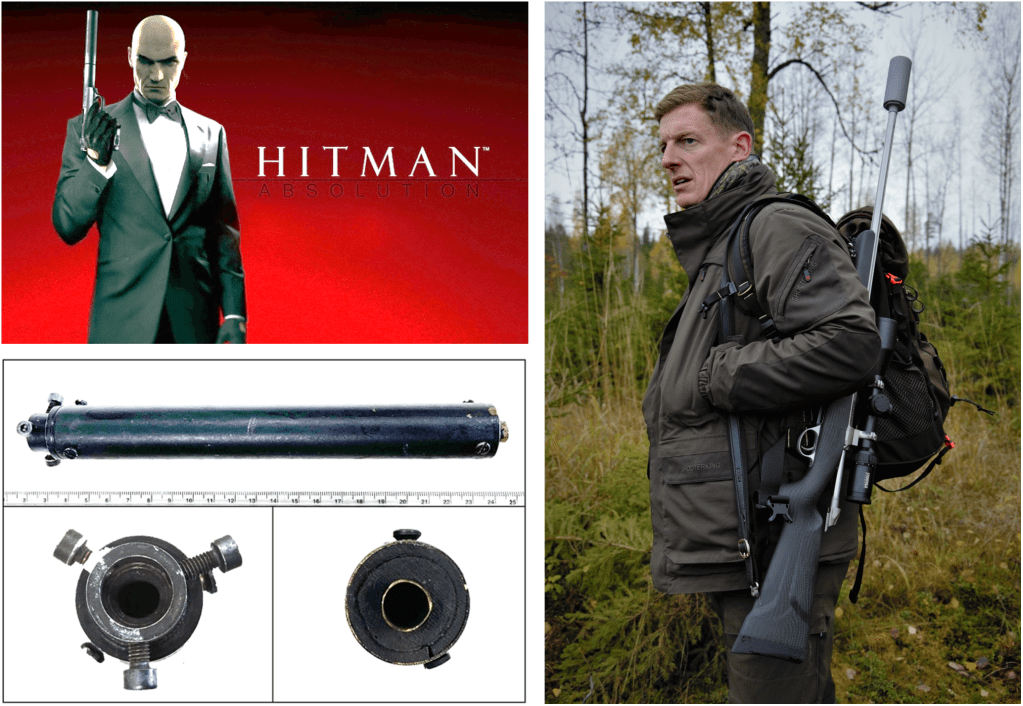
Silencers are often associated with hitmen in popular media, but they are more commonly used by hunters to improve their stealth, making them an accessible item for sale across many countries (Fig 1). In the United States, the 1934 National Firearms Act regulated the sale of suppressors under the requirement of a $200 tax, which is currently enforced by the Bureau of Alcohol, Tobacco, Firearms & Explosives (ATF). In Europe, regulations vary by country; most allow the purchase of silencers for hunters (e.g. Denmark, Poland, Portugal) but in some countries, both the sale and purchase are illegal to citizens (e.g. Spain, Italy). Therefore, silencers remain a consideration for their use in various crimes, especially around hunting regions worldwide.
What isn’t known about silencers is how they affect the gunshot residue (GSR) distribution and content – which are collected by investigators to perform their analytical tests. Particles of GSR are identified by their content and morphology: typically a combination of lead, barium, and antimony originating from the cartridge primer condensed into spherical particles of around 70 microns, or the diameter of a fly’s eye. Distance between the firearm and the target is calculated by the quantity and the spread of GSR around the bullet’s point of entry. If silencers are artificially changing the ability for particles to fly in the air, distance calculations could be greatly inaccurate and drop the probative value of the trace evidence.
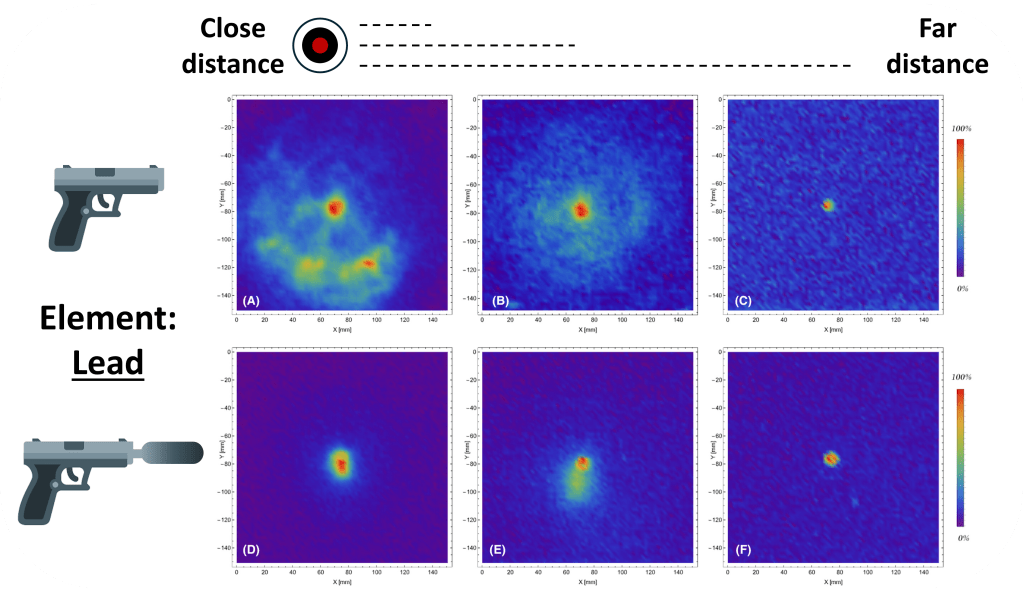
The scientists created a homemade silencer (Fig 1) attached to the end of a pistol. They first analyzed how the silencer changed the spread of GSR onto a target using X-ray fluorescence. This technique shoots X-ray beams at powder samples and determines the metal content based on the changes in irradiation. Lead, for example, produces specific changes that make its profile unique and easy to identify. The researchers plotted the lead distribution of the GSR from a suppressed and non-suppressed pistol, visualizing the distinct reduction in lead particle distribution as the distance between the shooter and the target increased (Fig 2). This indicates that when the bullet hole is large enough to suggest close fire, the distribution of lead can be used by crime scene investigators to determine if a silencer was used during the crime.
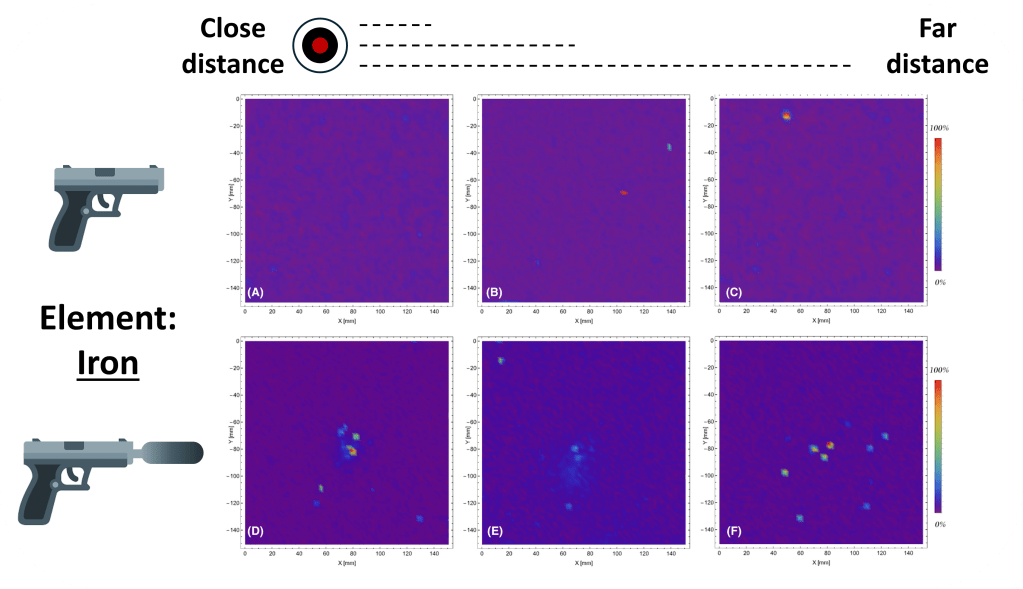
The researchers also wondered if they could distinguish the GSR composition itself from non-suppressed and suppressed weapons. Using the same method, the scientists showed that a silencer increased the amount of iron in GSR, which is normally present in low quantities. The iron particles resembled swarf, or the metal chips cast off during machining or filing, likely originating from the machining process of the homemade silencer (Fig 3). This means that CSI techs could distinguish a bullet made from a suppressed and a non-suppressed gun based on the presence of iron-containing swarf in the GSR. However, advanced machining with good post-machining QC could remove this potential evidence; therefore, further study with a larger sample size of silencers from different vendors would empirically support
In the future, this method could be included in the standard practice of trace evidence examiners to increase the amount of information obtained from gunshot residue. Laboratory techs typically follow internal practices derived from the ASTM international standards organization, which allows counties and countries to standardize their evidence interpretation and uphold high scientific rigor. The more information an investigator has, the more they can eliminate or include suspects and find the culprit of a violent, gun-related crime.
| Study title: | Effect of mounting a sound suppressor on distribution and total amount of inorganic gunshot residue on targets |
| Study authors: | Matteo Donghi, Alessandro Girella, Debora Pellegrino, Federica Maraschi, Antonella Profumo, Chiara Milanese, Daniele Merli* (corresponding author) |
| Journal: | Journal of Forensic Science (publisher – Wiley) |
| Year published: | 2025 |
| URL | https://onlinelibrary.wiley.com/doi/10.1111/1556-4029.70025 |
| Open access? | Yes! No paywall |


